
Quick and Reliable Nintendo Switch Screen Repair Services

Nintendo Switch Screen Repair Services Vaughan: Expert Fixes, Costs, and Booking Guide

A damaged Nintendo Switch screen disrupts play and can hide deeper faults that affect performance, so understanding repair options is essential for owners. This guide explains what Nintendo Switch screen repair is, how technicians diagnose and fix cracked glass, LCD damage, and digitizer faults, and why timely, professional intervention restores functionality and preserves value. Readers will learn to identify common screen issues across Original, Lite, and OLED models, compare repair costs in the UK, follow the typical repair workflow, and book a repair with confidence. The article also compares DIY risks versus professional services, outlines model-specific repair differences, and summarizes complementary repairs such as Joy-Con drift and motherboard work. Throughout, target keywords like Nintendo Switch screen repair, Switch screen repair, cracked Switch screen, and Nintendo Switch OLED screen replacement are used to help you find practical, actionable answers and clear next steps.
What Are the Most Common Nintendo Switch Screen Issues?
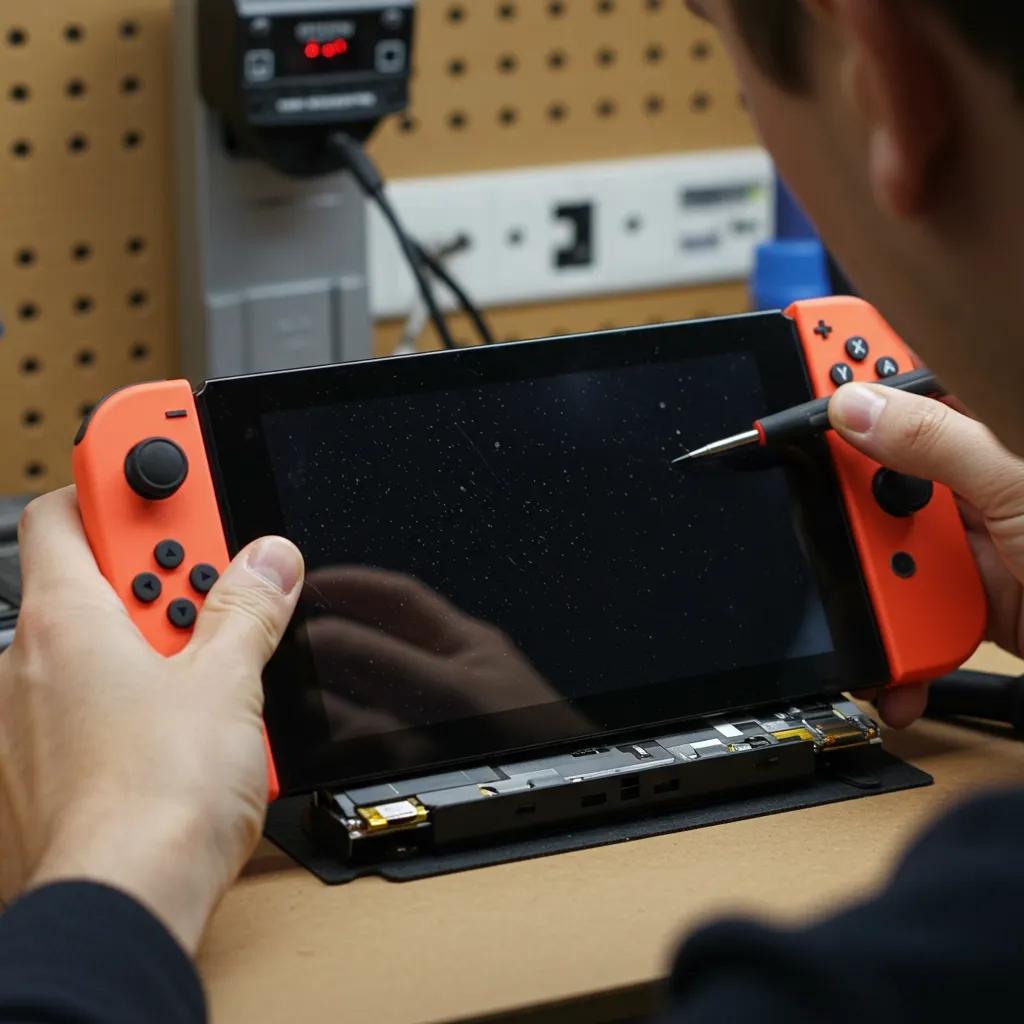
Nintendo Switch screen issues cover a predictable set of faults that affect display, touch response, and visual integrity; understanding each helps prioritize repair. Most problems fall into categories like cracked glass, digitizer failure, LCD damage causing black spots or bleeding, and flickering or unresponsive touch due to connectors or software. Identifying the underlying component—LCD panel, digitizer, or display connector—determines whether the repair is a glass-only, digitizer, LCD panel, or full screen assembly replacement. Early identification reduces the risk of secondary damage to the motherboard and helps technicians source the correct replacement parts quickly.
Common Switch screen faults and quick identifiers include:
- Cracked glass: Visible surface fractures without display distortion; touch may still work.
- Digitizer failure: Touch input not recognized while the image remains visible and undistorted.
- LCD black spots/bleeding: Dark splotches or halo effects within the image, indicating internal panel damage.
- Flickering or intermittent display: Lines, flicker, or intermittent backlight suggesting connector or panel faults.
These descriptions help owners decide whether immediate professional assessment is required and lead directly into how to visually and functionally identify specific damaged components.
How to Identify a Cracked Nintendo Switch Screen
A cracked Nintendo Switch screen shows surface fractures that are visually apparent and often localized to the glass layer; this is a physical break in the digitizer or protective glass. If the underlying LCD still displays colors and pixels correctly and touch input functions normally, the issue may be limited to the glass or digitizer layer. However, cracks that coincide with touch failure or display distortion suggest deeper damage to the digitizer or LCD panel, requiring fuller intervention. Photographing the screen and noting whether touch and image remain functional provides technicians with useful diagnostic clues prior to disassembly.
What Causes Unresponsive Touchscreens and Flickering Displays?
Unresponsive touch or flickering displays arise from failures in the digitizer, damaged display connectors, water ingress, or software/calibration issues that affect touch mapping. Physical shocks can dislodge the ribbon cable or damage the digitizer layers, while liquid exposure can corrode connectors and cause intermittent behavior. Software resets can sometimes restore calibration, but persistent faults typically require component-level inspection and replacement by trained technicians with ESD-safe equipment. Determining the root cause rapidly reduces unnecessary part replacements and shortens turnaround time.
How Do Black Spots and LCD Bleeding Affect Your Switch Screen?
Black spots and LCD bleeding occur when the liquid crystal layer or backlight is compromised, producing dark splotches, uneven brightness, or color bleeding that impair gameplay visibility. Pressure, punctures, or impact on the panel can rupture the LCD layers or displace liquid crystals, creating permanent black areas or halos around the damage. These faults are internal to the LCD panel and cannot be fixed by glass replacement alone; a full panel or assembly replacement is usually required to restore uniform display performance. Recognizing these symptoms early helps owners decide between repair and replacement options.
Which Nintendo Switch Models Are Most Prone to Screen Damage?
Different Switch models present distinct vulnerabilities based on design and materials: the Switch Lite has an integrated assembly that often requires whole-assembly replacement, the Original Switch has separable components that can be repaired selectively, and the Switch OLED uses a more fragile panel requiring specialist handling. Usage patterns—portable handheld play, carrying without protection, or frequent docking—also influence the risk of drops and pressure damage. Identifying the model informs the likely repair complexity and parts needed, which in turn affects price and turnaround expectations.
How Much Does Nintendo Switch Screen Repair Cost in the UK?
Repair cost for a Nintendo Switch screen in the UK depends on model, whether the LCD or digitizer is affected, and whether a full screen assembly replacement is required; typical UK price ranges reflect these variables. Price drivers include part type (LCD vs OLED), labor required for disassembly and calibration, and availability of quality replacement parts. A transparent price table below summarizes typical ranges for common repairs across models to help owners compare options and plan budgets. Free diagnostic services and clear quotes reduce surprises and help owners make informed decisions before authorizing work.
| Model | Repair Type | Typical Price Range |
|---|---|---|
| Original Switch | LCD panel replacement | £60 - £120 |
| Original Switch | Digitizer (touch glass) replacement | £50 - £100 |
| Switch Lite | Full screen assembly replacement | £70 - £140 |
| Switch OLED | OLED panel / full assembly replacement | £120 - £220 |
These ranges illustrate how OLED parts and whole-assembly replacements command higher prices due to parts cost and specialist handling; always confirm with a diagnostic before proceeding.
What Is the Price Range for LCD Screen Replacement?
LCD screen replacement typically falls in the lower-to-mid range for Original Switch models, reflecting lower parts cost compared with OLED panels and the ability to replace components individually. Prices vary when additional damage exists—such as bent frames or connector faults—that extend repair time and parts required. A free diagnostic assessment clarifies whether only the LCD panel is needed or if digitizer or frame repairs are also necessary, enabling a clear quoted price. Owners should account for potential additional charges when motherboard or connector damage is discovered during disassembly.
How Much Does OLED Screen Replacement Cost Compared to Other Models?
OLED screen replacement costs more than LCD repairs because OLED panels are pricier and require careful, specialist handling to avoid electrostatic or burn-in issues during replacement. Typical OLED repair ranges reflect both higher parts cost and the need for precise calibration after fitting to ensure color accuracy and touch responsiveness. Compared with Switch Lite and Original Switch repairs, OLED replacements sit at the top of the price spectrum and often take longer to source and fit. Owners should weigh OLED repair cost against device age and other faults when deciding to proceed.
Are There Transparent Pricing Options for Switch Screen Repairs?
Transparent pricing options include free diagnostics, fixed quotes after inspection, and clear explanations of what the quoted price covers, such as parts, labor, calibration, and warranty. A 'no fix, no pay' policy and a standard warranty window further build confidence because owners only authorize work after receiving a clear estimate. When booking a repair, request an itemized quote that separates part costs and labor so you understand what you pay for and can compare like-for-like across service providers. Clear pricing reduces friction and avoids unexpected charges when additional faults are discovered.
What Does a Full Screen Assembly Replacement Include?
A full screen assembly replacement typically includes removal of the damaged glass and LCD, replacement with a new digitizer and panel assembly, reinstallation into the housing, and post-repair calibration and functional testing. For models with integrated assemblies—like the Switch Lite—the replacement often encompasses the frame and connector mates to ensure structural integrity. After reassembly, technicians perform multi-point testing of touch response, display uniformity, and connectivity to Joy-Con and dock functions. A full assembly replacement restores both appearance and function to pre-damage levels when performed with quality parts.
Why Choose Professional Nintendo Switch Screen Repair Services?
Choosing a professional Nintendo Switch screen repair service reduces the risk of further damage, preserves warranty where possible, and restores functionality using tested parts and controlled procedures. Professionals use diagnostic tools to isolate faults accurately, source quality components suited to each model, and perform repairs in ESD-safe environments to protect the motherboard and internal connectors. Professional services also provide formal warranty terms and transparent policies that protect customers if a repair does not resolve the issue. These combined benefits make professional repair a safer, longer-lasting solution than unverified DIY fixes.
Professional repairs offer key advantages over DIY attempts:
- Accurate diagnosis: Trained technicians identify whether the fault is glass, digitizer, LCD, or a connector issue.
- Controlled environment: Repairs are carried out with ESD protection and specialized tools to prevent collateral damage.
- Post-repair testing: Full functional checks and calibration reduce the chance of recurring faults.
These advantages lead to more reliable outcomes and connect directly to consumer trust signals like warranty coverage and no-fix guarantees.
What Are the Risks of DIY Nintendo Switch Screen Repairs?
DIY Nintendo Switch screen repairs risk damaging delicate connectors, misaligning digitizer layers, or harming the motherboard with ESD or excessive force, which can convert a single-component repair into an expensive motherboard repair. Inexperienced repairs commonly miss hidden faults discovered only after partial disassembly, leading to repeated disassembly and higher cumulative costs. DIY attempts also often void manufacturer or third-party warranties and remove recourse in case of follow-up issues. Because of these risks, many owners choose professional assessment and repair to safeguard device functionality and value.
How Do Expert Technicians Ensure Quality Repairs?
Expert technicians ensure quality through structured diagnostics, proven repair workflows, use of quality replacement parts, and systematic post-repair testing that covers touch response, display uniformity, and functional integration. Training in model-specific disassembly prevents connector damage and preserves serialized components during repair. Technicians also implement quality-control checks such as burn-in and stress testing to confirm stability before returning the device to the owner. This disciplined approach reduces return rates and increases the likelihood of long-term repair success.
Why Are Quality Parts Important for Switch Screen Replacement?
Quality parts impact display clarity, touch sensitivity, and long-term reliability; OEM or high-quality aftermarket components closely match original specifications and reduce the likelihood of early failure. Poor-quality parts may exhibit color mismatch, reduced touch responsiveness, or premature delamination, causing repeat visits and greater lifetime cost. Using verified parts with traceable sourcing and pre-installation testing ensures the replacement performs as intended and supports any service warranty offered. Part quality therefore directly affects both immediate user experience and future device value.
What Warranty and Service Guarantees Are Offered?
Reliable repair services typically include a warranty period that protects against defects in parts and workmanship and a 'no fix, no pay' policy that reduces financial risk if the issue cannot be resolved. One clear trust signal to look for is a defined warranty window that covers the replaced screen and associated labor for a stated period after repair. When choosing a provider, confirm the warranty length, what it covers, and any exclusions so you know your options if the fault reoccurs. These guarantees provide peace of mind and reflect a provider's confidence in their repair standards.
After explaining the value of professional services, consider iPace Electronics' offering for Nintendo Switch owners seeking a trusted provider. iPace Electronics lists a Gaming Console Service that includes Nintendo Switch repairs and promotes expert repairs with qualified technicians, quality parts, a free diagnostic assessment, a 90-day warranty, quick turnaround, and transparent pricing under a 'No Fix, No Pay' policy. These specific service features help owners seeking assurance and clarity before they commit to repairs.
How Does the Nintendo Switch Screen Repair Process Work?

The Nintendo Switch screen repair process follows a structured workflow from booking and diagnostic to parts sourcing, repair, testing, and return, ensuring each stage reduces risk and clarifies costs for the owner. A clear stepwise approach shortens turnaround times and sets expectations at each touchpoint, including communication about approvals and return shipping for postal workflows. The EAV table below summarizes stages, what technicians do, and what customers receive to make the process transparent and snippet-friendly for quick reference. Knowing the stages helps owners prepare the device for shipping or drop-off and anticipate the timeframe for repair completion.
| Stage | What We Do | What Customer Receives |
|---|---|---|
| Diagnostic | Visual inspection, functional tests, connector checks | Written diagnostic report and price quote |
| Approval | Customer approves quote or declines | Confirmation of next steps and ETA |
| Repair | Parts replacement, reassembly, calibration | Repaired device with tested display and touch |
| Quality Check & Return | Burn-in and functional tests, packaging for return | Receipt, warranty details, and return shipping info |
What Happens During the Free Diagnostic Assessment?
During a free diagnostic assessment, technicians perform a visual inspection, run functional tests of the display and touch, check display connectors, and examine for water or board-level damage to determine the repair scope. The diagnostic identifies whether the fault is confined to glass, digitizer, panel, or if further motherboard-related repairs are needed. Technicians then prepare an itemized quote showing parts and labor so the owner can approve the repair before work begins. This transparent diagnostic step reduces surprises and forms the basis for any confirmed fix.
How Are Replacement Parts Sourced and Tested?
Replacement parts are sourced from verified suppliers and undergo incoming quality checks that assess fit, display uniformity, and digitizer responsiveness before installation. Preference for higher-quality or OEM-equivalent parts lowers the risk of post-repair failures and supports warranty coverage. Technicians test parts on a bench setup where possible prior to final assembly to confirm compatibility and performance. These sourcing and testing practices ensure that fitted parts meet expected visual and functional standards.
What Is the Typical Repair Turnaround Time?
Typical repair turnaround time for screen repairs ranges from one to five business days depending on model, part availability, and whether postal shipping is involved; express options may reduce this timeframe. Turnaround extends if OLED parts must be sourced or if additional motherboard work is required after diagnostic. Owners opting for postal repair should add shipping transit times to the estimate and insure the device for transport. Clear communication about estimated completion dates helps manage expectations and supports planning.
How Can Customers Book and Receive Their Repaired Switch?
Customers can typically book by online form, phone, or by dropping the device off in person, and choose between in-store collection or postal return options; each method has pros and cons relating to speed and convenience. For postal repairs, owners pack the device securely, include contact details and tracking, and send with insured shipping; technicians confirm receipt and provide status updates during repair. After repair, the device is tested and returned via the chosen shipping method or collected in-store, with warranty documentation provided at handover. Clear booking channels and return options streamline the process and minimize downtime.
A numbered checklist outlines a simple booking workflow:
- Prepare device: Back up data where possible and remove loose accessories.
- Choose booking method: Drop-off, phone, or postal booking as supported by the provider.
- Accept diagnostic quote: Authorize the repair after receiving a clear itemized quote.
- Receive repaired device: Collect in-store or receive return shipping with warranty details.
What Are the Differences Between Nintendo Switch, Switch Lite, and Switch OLED Screen Repairs?
Model-specific differences arise from variations in screen construction, assembly integration, and panel technology; these factors determine repair complexity, parts required, and cost. The comparative table below highlights the screen type and repair complexity notes for each model to illustrate why OLED repairs demand specialist handling while Lite repairs often require whole-assembly replacements. Understanding these differences helps owners set realistic expectations around cost and turnaround time for their specific device.
| Model | Screen Type | Repair Complexity/Notes |
|---|---|---|
| Original Switch | LCD + separate digitizer | Moderate complexity; components separable for targeted repair |
| Switch Lite | Integrated assembly | Often requires full assembly replacement; higher labor to replace frame |
| Switch OLED | OLED panel | High complexity; specialist handling and calibration required |
How Is the Original Nintendo Switch Screen Repair Different?
The Original Nintendo Switch permits a more modular repair approach because the LCD and digitizer are relatively accessible and connectors can be replaced without removing entire housings. Technicians can often replace only the damaged component—glass, digitizer, or LCD—reducing parts cost and repair time when the damage is isolated. However, connector damage or housing distortion can complicate what appears to be a simple screen repair. Accurate diagnosis preserves the option of selective component replacement and lowers overall repair expense when feasible.
What Makes Switch Lite Screen Repairs Unique?
Switch Lite repairs are unique because the screen is typically integrated into the device assembly, making individual component swaps more difficult and often necessitating a full assembly replacement. This integrated design increases part cost and labor because the entire display/frame unit must be removed and replaced to restore functionality. Consequently, Lite repairs can be slightly more expensive relative to simple LCD swaps on the Original Switch, and owners should expect whole-assembly lead times in the quote. Knowing this upfront helps set realistic cost expectations.
Why Does the Switch OLED Require Specialized Repair Techniques?
The Switch OLED uses an OLED panel that is thinner, more sensitive to static and pressure, and requires precise calibration to achieve correct color and contrast, so repairs demand specialist techniques and careful ESD-safe handling. OLED panels can be more fragile during removal and installation, and improper handling risks introducing burn-in, color shift, or connector damage. Technicians experienced with OLED replacements perform additional validation steps post-install to ensure color balance and touch responsiveness meet original standards. These precautions raise the cost and often the turnaround time for OLED repairs.
How Do Repair Costs Vary Across These Models?
Repair costs generally rank from lowest to highest as Original Switch selective repairs, Switch Lite full-assembly replacements, and Switch OLED specialized panel replacements due to part cost and handling complexity. Factors such as availability of quality parts, required labor for frame realignment, and any discovered motherboard faults further influence final pricing. Asking for an itemized quote that states the exact parts and labor components helps owners compare costs across models. Understanding model-specific price tiers assists in making a cost-effective repair decision.
What Are the Most Frequently Asked Questions About Nintendo Switch Screen Repairs?
This FAQ-style section answers common PAA queries in concise, snippet-friendly sentences to help owners find fast, direct answers about turnaround, DIY feasibility, repair value, and local service options. Short, clear responses support featured snippet capture and guide readers toward the next practical step—diagnostic booking or contacting a reputable service provider. Each answer focuses on a single clear point, followed by a brief elaboration and next action cue.
How Long Does a Nintendo Switch Screen Repair Take in the UK?
A typical Nintendo Switch screen repair takes between one and five business days depending on model, part availability, and whether postal shipping is involved; express options may reduce this timeframe. Turnaround extends if specialist parts must be ordered or if additional motherboard diagnostics reveal further faults. Postal repairs add transit time for insured shipping to and from the service center, so plan accordingly. Always confirm the expected completion date when approving the quote.
Can I Replace My Nintendo Switch Screen Myself?
While technically possible for experienced technicians with the right tools, DIY replacement carries significant risk of damaging connectors, the motherboard, or causing poor reassembly, and it often voids warranty protections. DIY may be reasonable for those with prior repair experience and ESD-safe tools, but most owners achieve better long-term value and reliability using professional services. If you do attempt DIY, follow verified guides and test components before final assembly.
Is It Worth Repairing a Cracked Nintendo Switch Screen?
Repair is worth it when the repair cost is significantly lower than the replacement value, when the device has no major additional faults, or when sustainability and avoiding e-waste are priorities; otherwise, replacement may be preferable. Consider device age, existence of other faults, resale goals, and the quoted repair price when deciding. A transparent diagnostic and itemized quote will help determine whether repair or replacement yields better value. Repair often remains the greener and more economical option for otherwise healthy consoles.
Where Can I Get Reliable Nintendo Switch Screen Repair Services Near Me?
Reliable repairs are available through local service centers or postal repair providers that offer clear diagnostics, itemized quotes, and warranty coverage; check provider listings and customer reviews and confirm postal workflows if you are nationwide. Many services support both drop-off and postal repairs to cover customers outside a local catchment area. For in-person service, verify that the provider performs multi-point testing and offers a written warranty. Use the provider’s diagnostic process and warranty terms as selection criteria.
How to Book Your Nintendo Switch Screen Repair with iPace Electronics?
Booking a repair with iPace Electronics can be done via their online booking channels or by arranging drop-off or postal service, and the provider's Gaming Console Service explicitly covers Nintendo Switch repairs. The booking process begins with a free diagnostic assessment, followed by an itemized quote that owners must approve before repairs commence. For postal repairs, owners should follow packing and insurance guidance and expect communication at key stages—receipt, diagnostic result, repair commencement, and dispatch. iPace Electronics provides a transparent pricing approach and a 90-day warranty on qualifying repairs under their stated policies.
What Are the Available Booking Methods?
Available booking methods typically include an online booking form, phone contact, and in-person drop-off at the service address; choose the option that suits your convenience and urgency. When booking online or by phone, provide device model information and a brief fault description to expedite the diagnostic process. For in-person visits, confirm any appointment requirements to reduce waiting time. Clear booking choices make it easier to start the repair process promptly.
How Does the Postal Repair Service Work for UK Customers?
Postal repair service involves securely packaging the Switch, including contact details and a brief fault description, sending it with insured tracked shipping to the service provider, and receiving status updates during diagnostic and repair stages. Providers usually confirm receipt, perform the free diagnostic, supply a quote, and await approval before proceeding. Once repaired and tested, the device is returned via the selected shipping method or collected in-store, with warranty documentation included. Postal service allows owners outside local areas to access certified repairs efficiently.
What Should Customers Expect After Booking?
After booking, customers receive confirmation of the appointment or shipping instructions, followed by a diagnostic report and itemized quote once the device is assessed; repair proceeds only after approval. Throughout repair, expect status updates at key milestones—diagnostic completion, parts ordering, repair completion, and dispatch or collection notice. On completion, owners receive the repaired device with testing documentation and warranty details. This predictable communication reduces uncertainty and ensures transparency.
What Additional Nintendo Switch Repair Services Does iPace Electronics Offer?
Beyond screen work, many providers offer complementary services such as Joy-Con drift repair, charging port and battery replacement, and complex motherboard repair that address faults often discovered alongside screen damage. Bundling related repairs can save time and potentially reduce the total labor cost by addressing multiple issues in a single service visit. iPace Electronics lists Gaming Console Service as covering these complementary repairs, enabling owners to consolidate repairs and simplify logistics when multiple faults exist.
Common complementary services include:
- Joy-Con drift repair: Calibration and component replacement to restore accurate control input.
- Charging port repair: Repair or replacement of the USB-C connector to restore reliable charging and dock connection.
- Battery replacement: Swapping degraded batteries to restore run time and device stability.
- Motherboard repair: Complex diagnostics and component-level soldering when screen faults co-occur with board-level damage.
How Is Joy-Con Drift Repaired Alongside Screen Issues?
Joy-Con drift is diagnosed by checking analog stick readings and recalibration routines, then resolved by cleaning, replacing worn modules, or performing calibration and firmware checks; addressing drift alongside screen issues consolidates diagnostics and reduces overall turnaround. Combined repair workflows allow technicians to test controller responsiveness and screen functionality together after reassembly, ensuring integrated performance. Bundling reduces shipping and labor duplication compared with separate repair sessions. Coordinated repairs therefore speed return to play and simplify warranty coverage.
What Are the Options for Charging Port and Battery Replacement?
Charging port faults often present as intermittent charging or failure to dock, and repairs consist of connector replacement and testing for continuity and power delivery; battery replacement restores diminished run time and stabilizes device operation. Technicians test charging current and inspect for corrosion or physical damage that could affect the board. Turnaround for these repairs is typically quick when parts are in stock and can be combined with screen work to reduce overall downtime. Clear post-repair testing ensures safe charging and accurate battery readings.
When Is Motherboard Repair Necessary?
Motherboard repair is necessary when diagnostics reveal power faults, persistent display communication failure after screen replacement, water damage, or component-level failures that affect multiple subsystems. These repairs are more complex, sometimes requiring micro-soldering and component-level replacement, and they carry higher labor and parts costs. Technicians will recommend motherboard repair only when diagnostic evidence indicates the board, not the screen or connector, is the fault source. Owners should weigh cost and device age when authorizing board-level interventions.
This article has outlined the common screen faults, cost expectations, repair workflow, model differences, and booking options for Nintendo Switch screen repair in the UK. By following the diagnostic steps, comparing transparent quotes, and choosing reputable providers with clear warranties—such as the Gaming Console Service offerings described—owners can restore their Switch with confidence and minimize downtime while protecting long-term device value.